Grinding vs. Full Removal — The Decision That Sets the Price
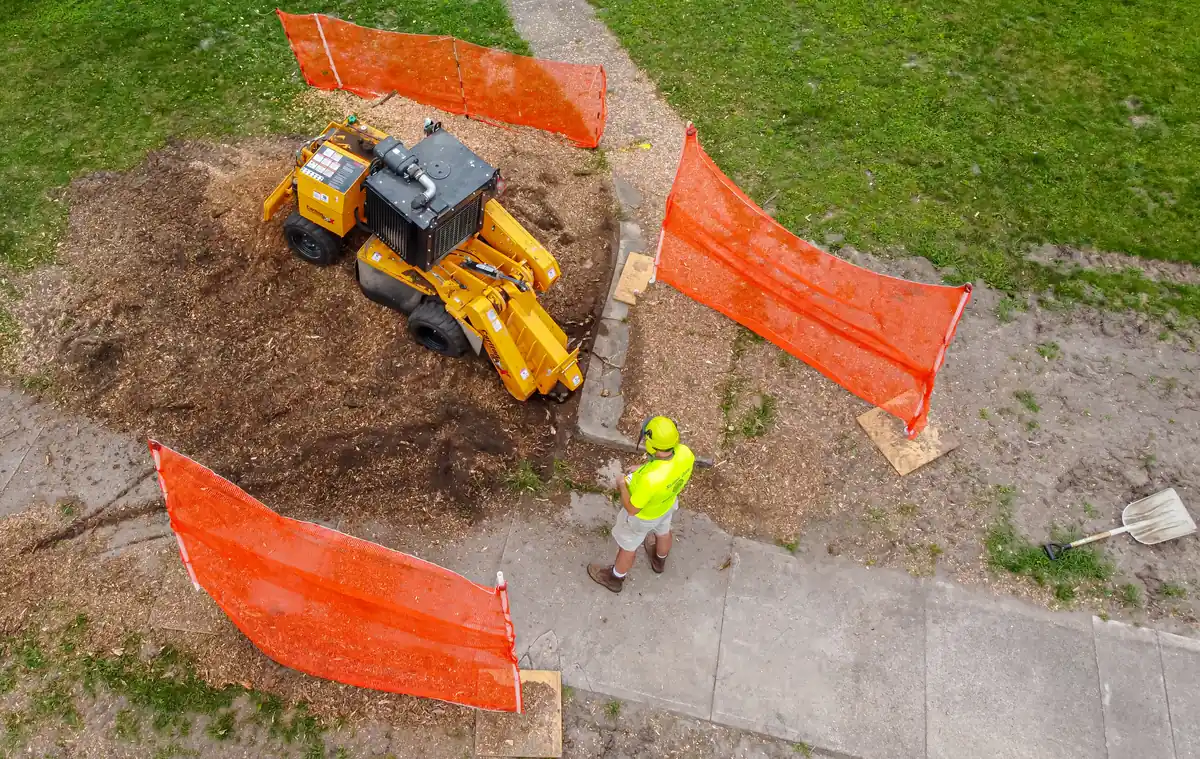 Photo: Wikideas1 (CC0)
These are two different jobs, and the right one depends entirely on what happens to that spot of ground afterward.
Stump Grinding
A grinding wheel chews the stump into chips, typically to about 6–12 inches below grade — deeper on request. The root system stays in the ground and decays naturally over years.
Right when: the goal is appearance, mowability, replanting grass, or reclaiming yard space. Grinding is faster, cheaper, and far less disruptive — a small hole backfilled instead of a crater.
Full Stump Removal
The entire stump and primary root ball comes out of the ground with an excavator, and the hole is backfilled and compacted.
Right when: you're building over the spot — house pad, garage, addition, driveway, retaining wall. Buried wood rots, rotting wood settles, and settling under a slab or footing is expensive forever. It's also the call when replacing a tree in the same hole or when roots are attacking a foundation or septic line.
The honest rule: grind for looks, remove for loads. Plenty of companies quote whichever they prefer to do; we quote what your end use requires.
Post-Clearing Stump Fields
The most common stump call we get isn't one stump — it's forty. Land gets cleared by a dozer operator or a logging crew, the trees vanish, and the owner is left with acres of stumps that make the land unmowable and unbuildable. We handle these as a package: grind or pull depending on your plans for the ground, fill and rough-level the holes, and hand back land you can actually use. If you're clearing land now, price the stumps into the original job — it's cheaper while the equipment is already on site, which is exactly how our lot clearing quotes are written.
What Happens to the Chips and the Hole
- Chips: grinding produces a surprising mound — a mix of wood and soil. Options: leave them to settle in the hole (they decompose and sink over time), spread them as mulch on beds and paths, or haul them off and backfill with soil for a seed-ready finish. Each is quoted honestly; haul-and-fill costs more.
- Holes: ground-out stumps leave a chip-filled depression; pulled stumps leave a real hole. We backfill and compact removal holes as part of the job — a stump hole someone "forgot" to fill is a twisted ankle or a mower accident waiting in tall grass.
- Root chasing: surface roots running out from the stump (maples and sweetgums are the usual offenders) can be chased and ground below mowing height for an added charge — tell us if roots, not just the stump, are the problem.
What Stump Work Costs in Clarksville
Ranges — stump pricing is genuinely count-and-size driven, so phone estimates are unusually accurate if you can measure:
- Single stump grinding: commonly $100–$400 per stump depending on diameter, with minimum charges around the low end covering mobilization
- Multiple stumps: per-stump price drops fast with count — a ten-stump job costs far less than ten single visits
- Per-inch rule of thumb: the industry's $3–$8 per inch of diameter range holds locally for straightforward access
- Full removal: typically 2–4× the grinding price for the same stump, plus backfill — the excavator, the hole, and the disposal are real costs
- Stump fields after clearing: priced per acre on site; access, stump density, and hardwood vs. cedar make ranges useless until we see it
Hardwood stumps (oak, hickory) grind slower than cedar and pine; rocky Montgomery County ground dulls teeth and slows everything. The free on-site quote is firm.
Frequently Asked Questions
What's the difference between stump grinding and stump removal?
Grinding chews the stump into chips 6–12 inches below grade and leaves the roots to decay — cheaper, faster, right for lawns and appearance. Removal pulls the entire stump and root ball out with an excavator — costlier, but required anywhere you'll build, pour, or drive, because buried wood settles as it rots. Match the method to the ground's future use, not to the lower quote.
How much does stump grinding cost in Clarksville?
Most single stumps run $100–$400 depending on size, or roughly $3–$8 per inch of diameter, with minimum charges applying to one-stump visits. Multi-stump jobs drop the per-stump price substantially. Count your stumps, measure the widest, and call (931) 440-8299 — stump work quotes well over the phone.
Can I build a garage or driveway over a ground stump?
No — grinding to standard depth leaves the root mass in place, and it will settle as it decays, cracking whatever sits on it. Anything structural needs full removal with compacted backfill, or at minimum deep grinding with engineered fill your builder signs off on. We'll tell you which your project needs before quoting.
How deep do you grind?
Standard is about 6–12 inches below grade — enough for grass, mowing, and replanting flowerbeds. We can grind deeper on request for shallow utilities, irrigation lines, or fussy landscaping plans; mention it when booking so the right machine shows up.
What do I do with the grinding chips?
Three options: leave them in the hole to settle (free, but expect a slow-sinking soft spot for a year or two), spread them as mulch, or have us haul them and backfill with topsoil for a seed-ready patch. Most homeowners spread or leave them; most pre-sale and pre-build jobs go haul-and-fill.